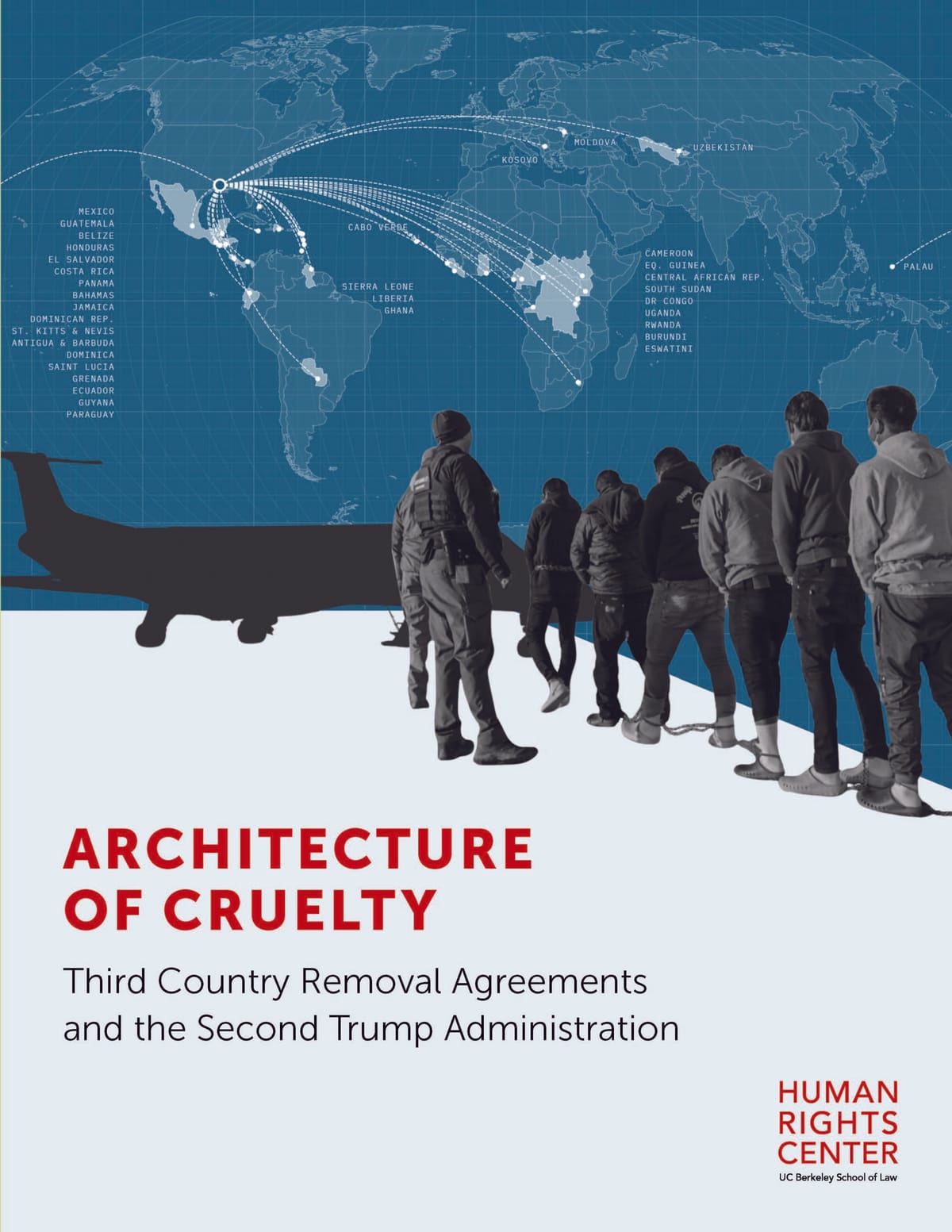
Report: Architecture of Cruelty: Third Country Removal Agreements and the Second Trump Administration

The Supreme Court will hear arguments in December on the lawfulness of the Trump administration's removal of noncitizens to third countries, i.e., countries where they are not from. Here is a resource with much relevant information for analysis of the case.
Carolyn Patty Blum, Clinical Professor of Law, Emerita, Berkeley Law, shared with me a report, Architecture of Cruelty: Third Country Removal Agreements and the Second Trump Administration. The report is a deep analysis of the network of agreements with third counties to accept noncitizens, with an emphasis on how they have changed over time. The report includes first person accounts and provides a robust digital resource library that contains a reading room housing all the agreements. In the dashboard are other methods of sorting the agreements and other materials, including financial information related to the agreements and a separate timeline. We hope they will be useful to others in the immigration community.
Here is the press release on the report:
"UC Berkeley Human Rights Center report "Architecture of Cruelty" exposes the Trump Administration's Third Country Removal system Berkeley, California: The Human Rights Center’s Investigations Lab at UC Berkeley School of Law today released “Architecture of Cruelty: Third Country Removal Agreements and the Second Trump Administration,” the first major legal and empirical analysis of the network of agreements the Trump administration has used to remove refugees and migrants to third countries with which they have no prior connection. The U.S. Supreme Court recently accepted review of the lower court’s decision finding this policy unlawful.
Drawing on 18 months of legal research and open source investigation — conducted in coordination with Forbidden Stories' global Deportation Project — researchers identified 35 countries with which the U.S. government has entered removal arrangements and 28 countries that have already received transferred individuals as of August 31, 2026. Many refugees and migrants had existing legal protections in the United States preventing their return to their home countries. Long-standing government policy allowed them to remain in the U.S.permanently. Despite this, the Trump Administration created an infrastructure of agreements to forcibly send these refugees and migrants to countries many of which have documented human rights abuses and deficient asylum systems. Most recently, Equatorial Guinea arrested and jailed two of the transferred refugees, an Egyptian and an Eritrean man, because they dared to film and decry the violence occurring where they were being detained.
“Architecture of Cruelty” includes the first-person accounts of people transferred under these arrangements, including individuals sent to Costa Rica, Ghana, Cameroon, and El Salvador's CECOT mega-prison. The accounts document cases in which people with existing U.S. court-ordered protections were transferred abroad, held in dangerous conditions, or forcibly returned to the countries they had fled.
The report is accompanied by an interactive Third Country Removal Agreements Dashboard, a Third Country Removal Timeline, and a Third Country Agreements Reading Room containing the underlying agreements, available at the Human Rights Center website.
Key Findings
The report identifies four types of removal arrangements: Asylum Cooperative Agreements, public agreements in the form of Memoranda of Understanding and Diplomatic Notes, nonpublic agreements, and informal "transit country" arrangements. Four patterns emerged across the agreement types:
● Receiving countries retain wide discretion to accept, reject, or screen transferees by nationality, criminal history, medical status, and even "professional skills," while the United States relinquishes any oversight or reporting obligations once a transfer is complete.
● Nearly every agreement includes assurances against refoulement, the forced return of a person to a country where they face torture and other forms of persecution. However, we have determined that many receiving countries are forcibly returning the refugees to their home countries. Furthermore, the report documents that several receiving countries lack the legal infrastructure for refugee protection, to honor these commitments. Further, in many receiving countries, people have been detained in dangerous, inhumane and degrading conditions, receive no social support and may be living on the street. Most concerning are the findings that many receiving countries are forcibly returning the refugees to their home countries.
● The report traces at least $50 million in direct payments to receiving governments and more than $144 million in related contributions to international organizations, alongside foreign officials' public statements describing pressure to accept transferees in exchange for continued U.S. aid or relief from visa and tariff restrictions.
● Since November 2025, the administration has moved away from signed, binding agreements toward "non-binding" memoranda and diplomatic notes that legal scholars warn reduces public disclosure and Congressional oversight. “Architecture of Cruelty” was authored by Linda Gordon, Carolyn Patty Blum, Payson Mayerle, Alexa Koenig, and Eric Stover of UC Berkeley's Human Rights Center’s Investigations Lab, with contributions from students at the Center's Investigations Lab and support from students at the UC Berkeley School of Law. It is one of a series of reports produced in collaboration with Forbidden Stories' Deportation Project — Inside the Trump Administration's Secret Deals to Expel People Worldwide. Report: https://humanrights.berkeley.edu/publications/architecture-of-cruelty/ Dashboard: https://humanrights.berkeley.edu/architecture-of-cruelty.html Reading Room: https://hrc.berkeley.edu/the-reading-room.html Timeline: https://hrc.berkeley.edu/graph.html
Human Rights Center Media Contact Maggie Andresen [[email protected]]