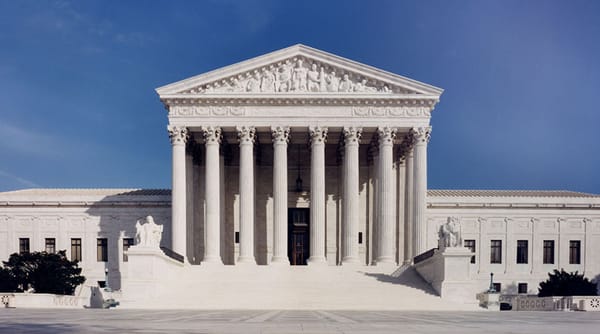
Trump v. Barbara Symposium: Bearing the Sins of the Father…. by Ediberto Roman


The Trump v. Barbara symposium continues:
Bearing the Sins of the Father…. by Ediberto Roman
On his first day in office President Donald Trump attempted to end birthright citizenship by executive fiat with the “Protecting the Meaning and Value of American Citizenship” executive order. With that act, we witness an assault on American children. Such a claim assuredly rings hyperbolic, but the truth is, with the executive order, the President has resurrected a legal firestorm that laid dormant for well over a decade—the effort to end birthright citizenship in order to curb undocumented immigration. Undocumented immigration was in the view of many a pivotal reason Trump won a second term in office.[1] Apparently, he did not forget this fact and is seeking to end birthright citizenship as part of his immigration priorities. President Trump thus seeks to rewrite the Constitution and over a century of Supreme Court precedent with the stroke of his pen. Birthright citizenship is a matter where for over three decades, I have been interviewed by national media, hosted podcasts, written books and law review articles, penned op-eds, and even dabbled with blog posts. Thus, my views on the revisionist and baseless efforts by conservatives to reimagine what the 39th Congress’ intent in drafting the 14th Amendment are indeed ample, and not the focus here.[2]
Instead, the views here touch upon the astonishing but rarely addressed aspect of the birthright citizenship debate; the fact that proposals to end the right seek to punish children born in our country who have done nothing wrong. Yes, children are the focus of Trump’s executive order. These children may ultimately be deported to lands they may have never even visited, and more importantly, these children who have done nothing wrong may have the right to have rights stripped from them. Indeed, their sin is being born in the U.S. of their parents who crossed the border without documentation. President Trump seeks to strip children of their birthright, effectively making them stateless at birth---not U.S. citizens—but perhaps, if they are lucky, citizens of lands they do not know and may have never visited. Depending how the decision of Trump v. Barbara is decided, it may leave U.S.-born children of undocumented immigrants paying for the wrongs of their parents.
Dating back to Biblical times, conventional thinking shunned having children bear the punishment for “sins of the father,” as observed in the Books of Ezekiel and Deuteronomy,[3] evincing an approach focusing on personal responsibility, and rejecting generational curses.[4] This is a premise that is now so grounded in our collective psyche that few today would find it reasonable to have a child imprisoned for a crime committed by one of their parents. Indeed, it seems unnatural to even suggest it. But that is exactly what the executive order seeks: to strip U.S.-born citizens of their birthright because their parents committed the misdemeanor of crossing the border without documentation.[5]
Forty-four years ago, in Plyler v. Doe, the U.S. Supreme Court struck down a Texas law that allowed public schools to deny education to the children of undocumented immigrants. In doing so, the Court articulated a foundational principle of American constitutional law: that children—particularly those present in the United States through no fault of their own—should not and cannot be punished for the actions or legal status of their parents.[6] Rooted in both logic and basic notions of justice, this principle has resonated across decades of jurisprudence: guilt is personal, and the sins of a parent may not be visited upon his or her child.[7]
In his majority opinion, Justice Brennan in Plyler,[8] tracked this logic, emphasizing that it was difficult—if not impossible—to conceive of a rational justification for penalizing the children of undocumented immigrants solely for their presence in the United States.[9] The Court drew a critical distinction between undocumented parents and their children: while the parents voluntarily chose to enter the country unlawfully and could thus be expected to bear the legal consequences of that decision, their children occupied a fundamentally different position.[10] As the Court noted, minors “can affect neither their parents’ conduct nor their own status.”[11] Unlike their parents, these children had no agency in the decision to immigrate and no realistic ability to conform their conduct to the law.[12] Holding them accountable for a wrong they did not choose—and could not control—was, in the Court’s view, both irrational and incompatible with basic tenets of justice.[13]
Yet, on his first day in office, President Trump signed Executive Order 14160, which purports to do to just that: having children pay for the “sins of their fathers” and mothers.[14] In doing so, the order directly attacks not only a century of U.S. Supreme Court decisions, the Constitution itself as well as its legislative history. Perhaps more Importantly, the executive order is an assault on the principle of personal accountability, i.e., not “bearing the sins of the father.” As expected, Trump’s executive order was met with immediate legal challenge.[15] Nevertheless, the so-called “New Birther” movement—led by figures such as Randy Barnett, Michael Anton, and John Eastman—continues to push a tortured reading of the 14th Amendment to strip U.S.-born children of their birthright. These Trump apologists argue that the 14th Amendment’s language that to be “subject to the jurisdiction thereof” requires not full subjection to U.S. law (which I have written extensively on: being the framers’ actual intent in 1868) but a kind of ‘subjective’ political allegiance on the part of the parent.[16] The view of the New Birthers thus not only contradicts the original understanding of the Citizenship Clause of the 14th Amendment and a long line of Supreme Court precedent, but it also ignores the very principle at the heart of the Plyler decision—that a child’s constitutional rights cannot be curtailed due to the unlawful actions of their parents.[17]
The common law as well as the U.S. Constitution has long rejected the idea that children should pay for the sins of their parents. This principle, known as the corruption of blood, prohibits punishing children for the acts of their parents. It was more widely seen in the context of laws discriminating against children born out of wedlock. The law has long rejected treating them as second-class citizens. The notion that children should not be made to pay for the misconduct of their parents, the "corruption of Blood principle, is deeply embedded in the Constitution."[18] Stripping children of their birthright for the wrongs of their parents acts with the executive order is nothing but an attempt to revitalize an arcane inequitable principle to punish the innocent.
In light of their attacks on jus soli and the Constitution itself, it appears both the New Birthers and the President have failed to grapple with basic tenets of humanity as well as the Supreme Court’s opinion in Plyler. Even if the executive branch somehow enforced the order—or accomplished the Herculean task of amending the Constitution—any effort to deny citizenship to children born in the United States solely because of their parents’ immigration status would directly violate not only the Plyler’s foundational ruling,[19] but also basic notions of decency. While the government may lawfully deport undocumented adults, it should never punish their children for acts they had no control over and strip them of rights that was theirs by birth. To do so is to violate not just our laws, but the most basic concept of American justice: that legal responsibility is individual, not inherited.[20]
[1] See Ediberto Roman, Despite Universal Condemnation, Trump Correct with the Mexican Traffic Threat, Value Journal on Regulation (2025), available at https://www.yalejreg.com/nc/despite-universal-condemnation-trump-correct-with-mexican-tariff-threat-by-ediberto-roman/
[2] See Ediberto Roman, Musings on Birthright Citizenship, The Faculty Lounge, April 6, 2026, available at https://thefacultylounge.org/2026/04/musings-on-oral-argument-on-birthright-citizenship/ : Ediberto Roman and Ernesto Sagas, Birthright Citizenship Under Attack, How Dominican Nationality Laws May Be the Future of American Exclusion, 66 Amer. U. L. Rev. 1383 (2017), available at https://digitalcommons.wcl.american.edu/cgi/viewcontent.cgi?article=2202&context=aulr ; Ediberto Roman, The Proposal to Elimin https://www.nytimes.com/roomfordebate/2015/08/24/should-birthright-citizenship-be-abolished/the-proposal-to-eliminate-birthright-citizenship-is-long-on-attacks-short-on-legality ate Birthright Citizenship Is Long on Attacks, Short on Legality, New York Times, (Dec. 22 2015) available at https://www.nytimes.com/roomfordebate/2015/08/24/should-birthright-citizenship-be-abolished/the-proposal-to-eliminate-birthright-citizenship-is-long-on-attacks-short-on-legality ; Ediberto Roman, CITIZENSHIP AND ITS Exclusions; A CLASSICAL, CONSTITUTIONAL, AND CRTICAL RACE CRITIQUE (NYU PRESS 2013).
[3] While the concept of the "sins of the father" is present in the Bible, it's important to note that other passages, such as Ezekiel 18 and Deuteronomy 24:16, emphasize individual responsibility and the idea that each person is accountable for their own actions.
[4] The Bible, Numbers 14 vs 18; “The Lord is longsuffering, and of great mercy, forgiving iniquity and transgression, and by no means clearing the guilty, visiting the iniquity of the fathers upon the children unto the third and fourth generation.”
[5] See 8 U.S.C. § 1325.
[6] Plyler v. Doe, 457 U.S. 202 (1982).
[7] Id.
[8] Id.
[9] Id. at 220.
[10] Id.
[11] Id.
[12] Id.
[13] Id.
[14] Exec. Order No. 14,160, 90 Fed. Reg. 1234 (Jan. 20, 2025), https://www.whitehouse.gov/presidential-actions/2025/01/protecting-the-meaning-and-value-of-american-citizenship/.
[15] Adam Liptak, Trump Asks Supreme Court to Allow Him to End Birthright Citizenship, N.Y. Times (Mar. 13, 2025), https://www.nytimes.com/2025/03/13/us/politics/trump-birthright-citizenship-supreme-court.html (last visited Mar. 24, 2025).
[16] Randy E. Barnett, The Misconceived Right to Birthright Citizenship, Claremont Rev. of Books (Fall 2018), https://claremontreviewofbooks.com/digital/birthright-citizenship/ (last visited Mar. 24, 2025); Michael Anton, Birthright Citizenship: Game On, Am. Mind (Jan. 17, 2024), https://americanmind.org/features/the-case-against-birthright-citizenship-2/birthright-citizenship-game-on/ (last visited Mar. 24, 2025); John C. Eastman, From Feudalism to Consent: Rethinking Birthright Citizenship, 16 Tex. Rev. L. & Pol. 167, 169–70 (2011).
[17] Plyler v. Doe, 457 U.S. 202 (1982).
- Max Stier, Corruption of Blood and Equal Protection: Why the Sins of the Parents Should Not Matter, 44 Stan. L. Rev. 727 (1992).
[19] Plyler v. Doe, 457 U.S. at 202.
[19] Id.