Breaking News: The Supreme Court Decides Mullin v. Al Otro Lado

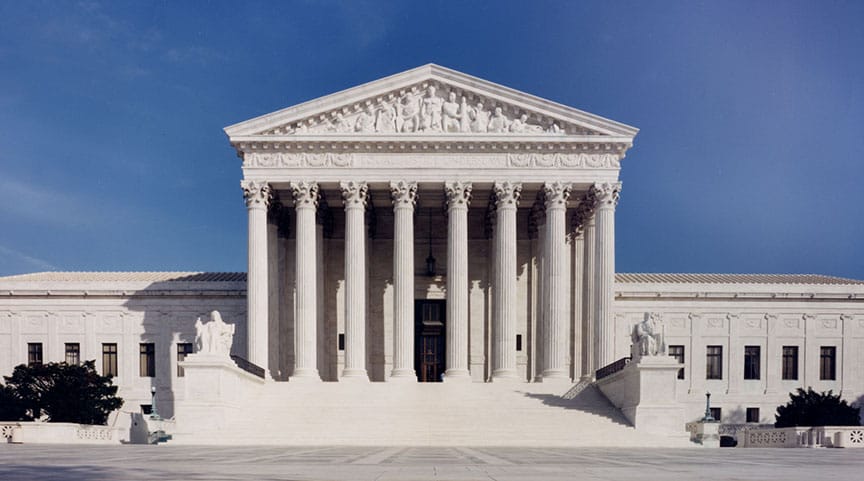
The Supreme Court today decides Mullin v. Al Otro Lado, which addresses the lawfulness of an immigration policy designed to manage the number of migrants coming to the U.S. border. Amy Howe for SCOTUSBlog describes the background of Mullin v. Al Otro Lado:
"The policy at the center of the dispute – known as `metering' – was adopted almost 10 years ago in response to a surge in the number of Haitian immigrants seeking asylum . . . . To implement it, [immigration officers at] the U.S.-Mexico border . . . turned back noncitizens without valid travel documents, including asylum seekers, before they could enter the United States. In 2017, the government extended that policy to all ports of entry across the U.S. border with Mexico . . . ."
Al Otro Lado, Inc., an immigrant rights group, and a group of asylum seekers brought suit to challenge the metering policy. A majority of the U.S. Court of Appeals for the 9th Circuit agreed with them that noncitizens turned away before they crossed the border had "arrived in" the United States.
The issue before the Court was whether a noncitizen stopped on the Mexican side of the U.S./Mexico border “arrives in the United States” under the immigration statute, which allows a noncitizen to apply for asylum.
The oral argument in the case left many observers with the impression that a majority of the Justices agreed with the U.S. government that the metering policy does not violate the law. They were right.
In an opinion by Justice Alito, a 6-3 Court reversed the Ninth Circuit. He begins:
"This case presents a straightforward question: whether an alien who seeks to enter the United States from Mexico `arrives in the United States' when he or she is still in Mexico. In the decision below, the . . . Ninth Circuit answered `yes.' That is wrong. In ordinary speech, no one would say that a person `arrives in' a place—for example, a house, a city, or a country—be fore the person enters that place. The context in which the phrase `arrives in the United States' is used in the immigration statutes at issue here supports an ordinary-meaning reading. So does the presumption against extraterritoriality. We therefore reverse." (footnotes omitted).
The Court focuses on the interpretation of the immigration statute. Still, the stakes are high for asylum seekers.
Justice Sotomayor read from her 35 page dissent (much longer than Justice Alito's majority opinion), which was joined by Justices Kagan and Jackson.
"The Court today holds that the Executive Branch may circumvent all these mandatory procedures by having U. S. immigration officers stand at the border and physically block noncitizens from setting a foot onto U. S. soil. They may do so even if the asylum seeker is at the threshold of a port of entry designated to receive all noncitizens who seek entrance into the country. Even if the port of entry has ample capacity to inspect that person, including an available asylum officer trained to process asylum applications. Even if the asylum seeker is certain to be persecuted, or killed, if she is turned away. The Court’s illogical interpretation is driven almost entirely by a fixation on a single word: `in.' Words, however, must be read in context and with attention to how they fit into the statute as a whole. The majority ignores the statutory context and history, not to mention the longstanding position of the Executive Branch, all of which show that any noncitizen arriving at our doorstep and seeking admission must be inspected and allowed to apply for asylum, regardless of whether her foot has crossed the threshold. Because the Court today blesses the Executive Branch’s decision to slam the door shut on all who are fleeing persecution, de spite the detailed inspection and asylum system that Congress enacted and commands, I respectfully dissent."
Justice Sotomayor ends her dissent on a powerful note:
"Congress passed the Refugee Act in 1980 because it did not want this country to repeat the mistakes of its past. Yet if the refugees on the M. S. St. Louis were to walk up to a port of entry on our southern border today, the majority’s interpretation would allow immigration officers to refuse even to consider their asylum applications by physically blocking them from stepping foot onto U. S. soil. The majority’s interpretation permits the Government to do that even if the refugees complied with all applicable laws and regulations, even if the port had ample capacity to inspect them, and even if turning them back would result in the very persecution from which they narrowly escaped. The consequences of today’s decision are predictable. More people will die. More people will attempt to cross the border illegally, and some will make it while others will not. More people will be forced to walk along the U. S.-Mexico border in dangerous conditions, trying to find a port that will inspect them. More people will turn back and be subjected to violence because of something they cannot or should not have to change about themselves, such as their race, religion, nationality, or political opinion. Because this is neither what Congress said nor what its words permit, I respectfully dissent." (footnote omitted).
Justice Jackson filed a separate dissent:
"Today, the Court issues an advisory opinion on the lawfulness of metering—a policy that has not been in place for almost five years and that the Government has no concrete plans to reinstate. In its rush to greenlight this retired practice, the majority elides serious justiciability concerns and decides legal issues entirely in the abstract. With potential mootness problems and without a factual record establishing how metering works in practice, the writ of certiorari in this case should never have been granted. I respectfully dissent from the Court’s unwise decision to plow ahead nevertheless. I also join JUSTICE SOTOMAYOR’s dissenting opinion because, in my view, her understanding of the Government’s asylum-processing obligations under 8 U. S. C. §§1158(a)(1) and 1225(a)(1) is correct."
More analysis coming soon.