UCLA Law Conference: 25 Years After 9/11

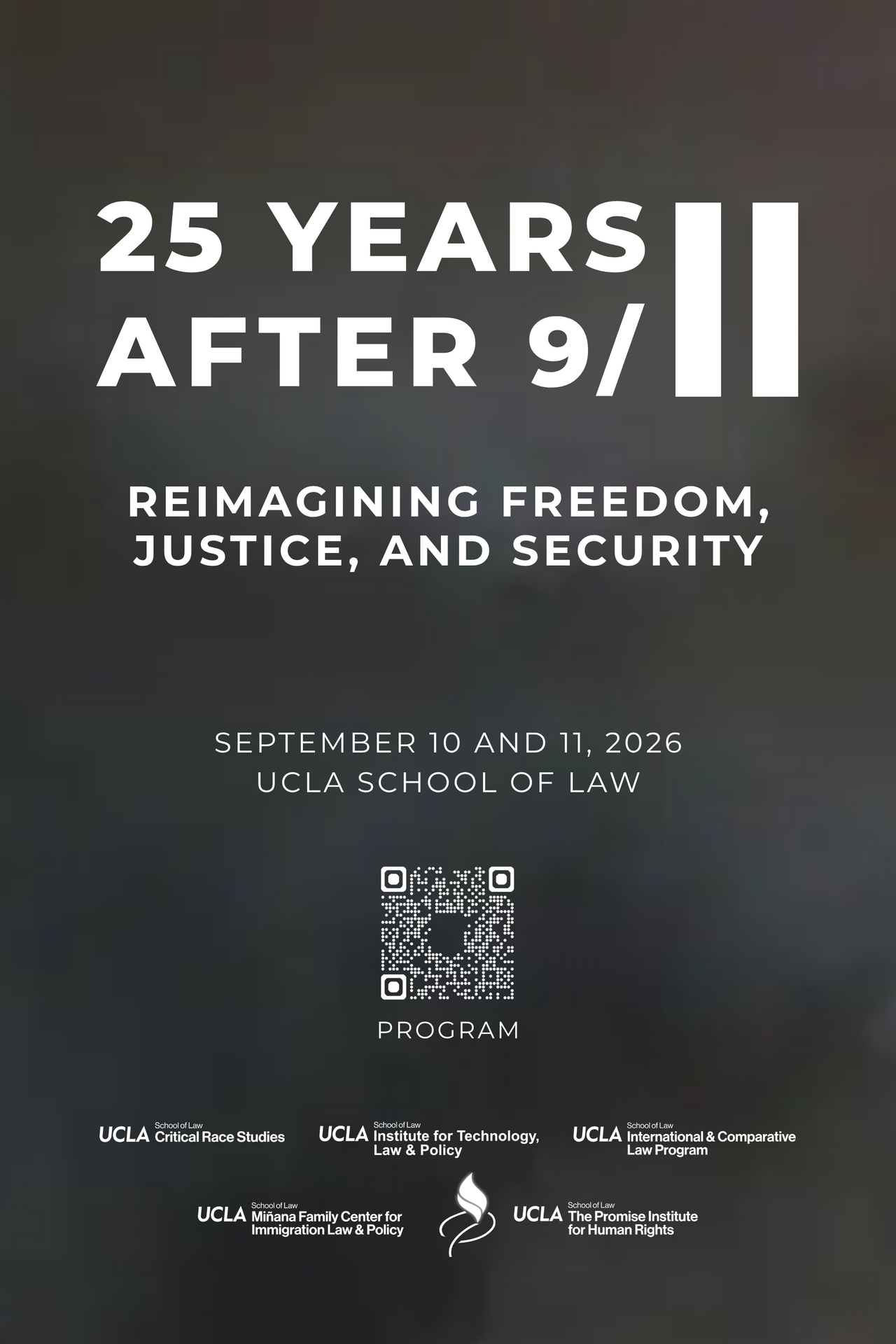
Twenty-five years after the attacks of September 11, 2001, the legal, political, and technological transformations initiated in response to the attacks continue to transform domestic and international law while reshaping the lives of communities targeted by racialized national security policies, immigration enforcement, policing, and war. This symposium will bring together scholars, advocates, and others to reflect on the legacies of the War on Terror and to imagine more just futures beyond its frameworks of fear, exclusion, and militarization. Sponsored by the UCLA School of Law’s Critical Race Studies Program, International & Comparative Law Program, Institute for Technology, Law & Policy, Miñana Family Center for Immigration Law & Policy, and Promise Institute for Human Rights. |
UCLA School of Law Room 1347 | September 10–11, 2026 |
Thursday, September 10, 2026 5:00–5:30 PM – Registration & Light Refreshments 5:30–7:00 PM – Opening Plenary 7:00–9:00 PM – Dinner Reception Friday, September 11, 2026 8:00–8:45 AM – Registration & Breakfast 8:45 AM–5:00 PM – Symposium |
For more information on the symposium, full program, and ways to contribute, please visit: |
Two panels on Friday may be of particular interest to blog readers:
1:00 – 2:15 PM: Borders, Migration, and National Security
The Department of Homeland Security (DHS) was created in 2002 to address national security concerns in the aftermath of the September 11 attacks. Over the last 25 years, however, DHS has expanded its reach to become the largest law enforcement agency in the U.S. And in recent years, much of that growth has focused on restricting immigration and eroding longstanding protections for all immigrants, from asylum seekers at the U.S. border to people who have lived in the country for decades. A panel of experts will discuss how the fight against terrorism has been weaponized in the immigration context, and what the future may hold for immigrants, now 25 years after the 9/11 attacks.
Panelists:
- Hiroshi Motomura, Susan Westerberg Prager Distinguished Professor of Law and Faculty Co-Director, Miñana Family Center for Immigration Law and Policy, UCLA School of Law
- Jennie Pasquarella, Interim Executive Director, the Seattle Clemency Project
- Silky Shah, Executive Director, Detention Watch Network
- Moderator: Julia Preston, Journalist and Author, Preston Report
2:30 – 3:45 PM: The Racialization of the War on Terror
The “Global War on Terror” declared by the United States government after 9/11 created new forms of and expanded existing state power, ostensibly race-neutral but racialized in enforcement. Concepts such as “radical Islam,” “political Islamist,” and “terrorist activity” criminalized religious identity, beliefs, and practices the U.S. government determined were threats to Western state hegemony in Muslim majority countries and White Christian nationalism in the homeland. The deeply racialized terms granted the state and private actors license to target Muslims and other racialized groups. Once normalized, the rights infringing practices expanded to a broad range of political activity challenging the status quo.
Panelists will discuss how “terrorism” and “material support” as concepts were deployed in racial terms; racial surveillance in mosques and later of “Black identity extremists”; contemporary anti-immigrant state action against racialized subjugated people under the guise of combatting “terrorism”; and the various black-listing and designation schemes, including the Department of Homeland Security’s “Designated Terrorist Organization” list, the “No-Fly” list, the Office of Foreign Assets Control’s “Specially Designated Nationals” list, and others. The panel will also discuss how these concepts have been weaponized to punish certain forms of dissent and protest in the United States, including political opposition to the genocide in Gaza.
Panelists:
- Amna A. Akbar, Benjamin N. Berger Professor in Criminal Law and Professor of Law, University of Minnesota Law
- Sunita Patel, Professor of Law and Faculty Director of the UCLA Veterans Legal Clinic, UCLA School of Law
- Wadie Said, Professor of Law, University of Colorado Law School
- Shirin Sinnar, Professor of Law, Stanford Law School
- Moderator: Sahar Aziz, Distinguished Professor of Law and Chancellor's Social Justice Scholar, Rutgers Law School